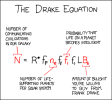
Actually, the chances are really small:
http://en.m.wikipedia.org/wiki/Drake_equation
While that equation is by no means perfect, its not a bad ballpark guess. What its great for is highlighting all the factors that come in to play here; there's a hell of a lot more to it than the number of galaxies.
Of course more goes into it than just number of planets. That formula is based on one galaxy. There are 50 billion galaxies. Also, in the equation it specifies only for life that has the ability to communicate(wich I assume means developed language), which there is one that we know of (us) and that is out of millions of species most of which have become extinct. Another variable is intelligent life (these are fraction that represent the same thing assuming intelligent life can be defined as one with language). So there is reason to believe the equation is flawed and can be used use as "liklihood" used in all these fractions is subjective constant, admitted to by the maker of the equation. But not to say that it is completely invalid.
the equation from wikipedia
Considerable disagreement on the values of most of these parameters exists, but the values used by Drake and his colleagues in 1961 were:
- R* = 10/year (10 stars formed per year, on the average over the life of the galaxy)
- fp = 0.5 (half of all stars formed will have planets)
- ne = 2 (stars with planets will have 2 planets capable of developing life)
- fl = 1 (100% of these planets will develop life)
- fi = 0.01 (1% of which will be intelligent life)
- fc = 0.01 (1% of which will be able to communicate)
- L = 10,000 years (which will last 10,000 years).
Drake's values give N = 10 × 0.5 × 2 × 1 × 0.01 × 0.01 × 10,000 = 10.
Remember, the equation is for ONE galaxy
now
1) The number of galaxies. An estimated 50 billion galaxies are visible with modern telescopes and the total number in the universe must surely exceed this number by a huge factor, but we will be conservative and simply double it. That's 100,000,000,000 galaxies in the universe.
2) The number of stars in an average galaxy. As many as hundreds of billions in each galaxy.
Lets call it just 100 billion.
That's 100,000,000,000 stars per galaxy.
3)The number of stars in the universe.
So the total number of stars in the universe is roughly 100 billion x 100 billion.
That's 10,000,000,000,000,000,000,000 stars, 10 thousand, billion, billion. Properly known as 10 sextillion. And that's a very conservative estimate.
So how many planets does 10 sextillion stars have?
I have to say, if anything, the equation shows a very strong likelihood of life existing elsewhere and does support the possibility of life even being advanced passed our own society.
The likelihood for one galaxy is very minute, I'll agree (assuming validity to the Drake equation), but that likelihood is mathematically far exceeded by the vastness of what we know to exist Also keeping in mind the flaws of what we know and understanding on how inter galactic physics work. Also to keep in note that there is still potential for our society to fail,there is no guarantees we will make it as a species. Simply put, we maybe the most advanced form of life out there, and we may not be. But even by the Drake equation the odds seem pretty damn good that earth is not the only host living organisms out there.



 How about UFOs?