a real alien/UFO thread

do you believe in aliens

  • Yes, I'm a believer that we're being visited by aliens

    Votes: 9 31.0%
  • Yes, I'm a believer but I don't think that they're visiting us, only that they're out there

    Votes: 15 51.7%
  • No, you're insane

    Votes: 2 6.9%
  • I think that UFOs are simply secret military aircraft

    Votes: 0 0.0%
  • Of course I believe, I've been abducted

    Votes: 3 10.3%

  • Total voters
    29

retro

Well-Known Member
2 2 2 2 1
How many of you all believe that in aliens, that is extra-terrestrial biological entities and not the kind you would find in California, Arizona, and Texas ;) How about UFOs?

Me personally, I'm a believer that we are being actively visited by beings from outside of our own planet. As far as UFOs go, I think that some of them are the craft being used by those beings, but a good chunk are actually secret military aircraft... primarily from the United States. I also think that there is a pretty decent chance that a lot of the technology we see today is as a result of reverse-engineering alien technology.

I probably sound crazy to a lot of you now ;) But what are everyone's thoughts. I think I've posted a similar thread before, but that was about a year ago and there are plenty of new faces around now.
 
There are billions of galaxies, each with billions of stars. Mathematically, the chances are very good and I would say likely that other life exists and at least one species is more advanced than us. However, if they do exist and have masted inter galactic travel, then what would they want with us?

We don't have much resources left and they risk any viruses we have when in contact. think influenza and what it did to Native Americans when the Europeans settled in.

Do I think they exist? Most likely

Do I think they are here? No, probably probing and keeping an eye on us to see how we advance, but not hanging around, not too much to gain from us if they have the capability to get here in the first place
 
Exactly, we share 99% genetic code with a chimpanzee and we think it's cute when they use a stick as a tool. Imagine a being that is 1% different then us in the other direction. Us developing the CERN Hardon collider is like a monkey using a stick to get food to them
 
I think it's very egotistical of us to think we're the only life in the universe. I would say that it's most definitely out there, in what form, who knows?

As for visiting us, it's not totally outside the realms of possibility, and there have certainly been plenty of sightings, but I really don't think little green men are checking us out. It's much more plausible that if we were to be visited it would be by robots, much like how we're currently exploring Mars.
 
There are billions of galaxies, each with billions of stars. Mathematically, the chances are very good

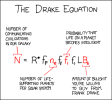
Actually, the chances are really small:
http://en.m.wikipedia.org/wiki/Drake_equation

While that equation is by no means perfect, its not a bad ballpark guess. What its great for is highlighting all the factors that come in to play here; there's a hell of a lot more to it than the number of galaxies.
 
I firmly believe there is life in the universe. I am fairly certain that there is intelligent life out there. But just as a matter of physics, I am highly skeptical that we have been visited or are being visited.
There may be ways to overcome faster than light travel that is beyond our mental capabilities, or a way to twist space/time, but no matter how you slice it, traveling millions of light years takes a very long time. Humans are very new to the scene. Did they decide to visit earth long before humans emerged, with hope life would emerge intelligent?
The time and distance is just too large to ignore in this debate. That's why I have a hard time imagining aliens visiting us.
 
Actually, the chances are really small:
http://en.m.wikipedia.org/wiki/Drake_equation

While that equation is by no means perfect, its not a bad ballpark guess. What its great for is highlighting all the factors that come in to play here; there's a hell of a lot more to it than the number of galaxies.

Beat me to it.
There's a fantastic BBC series called the wonders of the solar system that explains this and more.

Remember, the Universe is old, and the correct conditions for life to thrive on planets do not last forever. However, this works both ways. We know now that Mars cannot sustain life, but once it's atmosphere was of such different composition - it probably thrived.

Even in the "wrong" conditions, activity, if only ecological, can thrive. Take Titan, moon of Saturn, it is similar to Earth in that it has one liquid substance that covers most of it's surface and could possibly facilitate the growth of life.
But it isn't water - it's Methane. Our hydrosphere is as to their methosphere.
 
Actually, the chances are really small:
http://en.m.wikipedia.org/wiki/Drake_equation

While that equation is by no means perfect, its not a bad ballpark guess. What its great for is highlighting all the factors that come in to play here; there's a hell of a lot more to it than the number of galaxies.

The Drake equation is based on each galaxy... So while the number may be small for each Galaxy, you need to multiply that by the 100,000,000,000 galaxies out there.

Even if only 1 civilization in 1,000,000 galaxies exist, that would mean that any given time there would be over 100,000 planets with civilizations on them...

Some awfully big numbers we are dealing with.
 
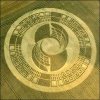
I think the crop circle phenomenom in the UK is pretty interesting, whether it's related to aliens is a different matter. They're getting seriously intricate though, well beyond what they used to be...

alien81102.jpg

yan-Wheel-Silbury+Hill,+Wiltshire,+2-3+August+2004.jpg

crop_circles_10003.jpg
 
Actually, the chances are really small:
http://en.m.wikipedia.org/wiki/Drake_equation

While that equation is by no means perfect, its not a bad ballpark guess. What its great for is highlighting all the factors that come in to play here; there's a hell of a lot more to it than the number of galaxies.

Of course more goes into it than just number of planets. That formula is based on one galaxy. There are 50 billion galaxies. Also, in the equation it specifies only for life that has the ability to communicate(wich I assume means developed language), which there is one that we know of (us) and that is out of millions of species most of which have become extinct. Another variable is intelligent life (these are fraction that represent the same thing assuming intelligent life can be defined as one with language). So there is reason to believe the equation is flawed and can be used use as "liklihood" used in all these fractions is subjective constant, admitted to by the maker of the equation. But not to say that it is completely invalid.

the equation from wikipedia

Considerable disagreement on the values of most of these parameters exists, but the values used by Drake and his colleagues in 1961 were:


0c37795c9852444997db9eac0a0ee2b3.png

  • R* = 10/year (10 stars formed per year, on the average over the life of the galaxy)
  • fp = 0.5 (half of all stars formed will have planets)
  • ne = 2 (stars with planets will have 2 planets capable of developing life)
  • fl = 1 (100% of these planets will develop life)
  • fi = 0.01 (1% of which will be intelligent life)
  • fc = 0.01 (1% of which will be able to communicate)
  • L = 10,000 years (which will last 10,000 years).
Drake's values give N = 10 × 0.5 × 2 × 1 × 0.01 × 0.01 × 10,000 = 10.

Remember, the equation is for ONE galaxy

now

1) The number of galaxies. An estimated 50 billion galaxies are visible with modern telescopes and the total number in the universe must surely exceed this number by a huge factor, but we will be conservative and simply double it. That's 100,000,000,000 galaxies in the universe.
2) The number of stars in an average galaxy. As many as hundreds of billions in each galaxy.
Lets call it just 100 billion.
That's 100,000,000,000 stars per galaxy.
3)The number of stars in the universe.
So the total number of stars in the universe is roughly 100 billion x 100 billion.
That's 10,000,000,000,000,000,000,000 stars, 10 thousand, billion, billion. Properly known as 10 sextillion. And that's a very conservative estimate.


So how many planets does 10 sextillion stars have?


I have to say, if anything, the equation shows a very strong likelihood of life existing elsewhere and does support the possibility of life even being advanced passed our own society.


The likelihood for one galaxy is very minute, I'll agree (assuming validity to the Drake equation), but that likelihood is mathematically far exceeded by the vastness of what we know to exist Also keeping in mind the flaws of what we know and understanding on how inter galactic physics work. Also to keep in note that there is still potential for our society to fail,there is no guarantees we will make it as a species. Simply put, we maybe the most advanced form of life out there, and we may not be. But even by the Drake equation the odds seem pretty damn good that earth is not the only host living organisms out there.

 
Keeping with the serious theme in the thread...

What makes you believe that we are being visited? Is it shows that you have watched, personal experience, just a hunch? I'm curious.

There are just so many stories out there with absolutely no real explanations. Barney and Betty Hill, Our Lady of Fatima, the Phoenix Lights, the ridiculously intricate crop circles that will appear overnight and how there seem to be weird gravitational fields in them, hell... even Roswell doesn't add up.

I've had a personal experience that I can't explain either.
 
I too think aliens/UFOs have come. Do I think they are here now, it would't suprise me either way. I think there are more things in the universe we don't know about than do. Today I'm having a real bad day at work and got some icky news from Joe so I wouldn't mind seeing some UFOs or aliens.....but no probing!
 
Back
Top