

Thats what dribbels out after you've finished and put it away. :mad
:24::24: and :yuk

Thats what dribbels out after you've finished and put it away. :mad



Thats what dribbels out after you've finished and put it away. :mad
I second that! :24::24: times like this thread make me glad Im a woman! :24:

 :nod:
:nod:
Here, and maybe this will help explain...
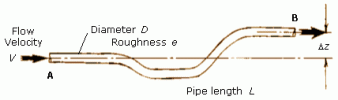
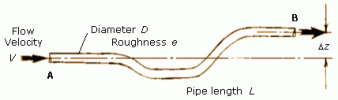
To calculate the pressure drop and flowrates in a section of uniform pipe running from Point A to Point B, enter the parameters below. The pipe is assumed to be relatively straight (no sharp bends), such that changes in pressure are due mostly to elevation changes and wall friction. (The default calculation is for a smooth horizontal pipe carrying water, with answers rounded to 3 significant figures.) Note that a positive Dz means that B is higher than A, whereas a negative Dz means that B is lower than A.

The Maulds is as confused as this guy
Here, and maybe this will help explain...
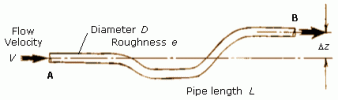
To calculate the pressure drop and flowrates in a section of uniform pipe running from Point A to Point B, enter the parameters below. The pipe is assumed to be relatively straight (no sharp bends), such that changes in pressure are due mostly to elevation changes and wall friction. (The default calculation is for a smooth horizontal pipe carrying water, with answers rounded to 3 significant figures.) Note that a positive Dz means that B is higher than A, whereas a negative Dz means that B is lower than A.
Does this clarify?
Pressure at A (absolute): Pa psi atm inHg inH2O ftH2O kPa Mpa mmHg
Average fluid velocity in pipe, V: m/s cm/s ft/s mph in/s Pipe diameter, D: m in ft cm
Pipe relative roughness, e/D: m/m in/in Pipe length from A to B, L: m in ft cm km mi
Elevation gain from A to B, Dz: m in ft cm
Fluid density, r: kg/m^3 lb/in^3 kg/l
Fluid viscosity (dynamic), m: cP Pa-s kg/m-s slug/ft-s
Does this clarify?
Pressure at A (absolute): Pa psi atm inHg inH2O ftH2O kPa Mpa mmHg
Average fluid velocity in pipe, V: m/s cm/s ft/s mph in/s Pipe diameter, D: m in ft cm
Pipe relative roughness, e/D: m/m in/in Pipe length from A to B, L: m in ft cm km mi
Elevation gain from A to B, Dz: m in ft cm
Fluid density, r: kg/m^3 lb/in^3 kg/l
Fluid viscosity (dynamic), m: cP Pa-s kg/m-s slug/ft-s
I explained it in plain english here folks
I explained it in plain english here folks
I think that was the English for petroleum products.
Get out the translation for pottie mouth.
We use essential cookies to make this site work, and optional cookies to enhance your experience.