The latest update on the Mercury Messenger mission.
Spacecraft Zipping Past Mercury
By
WARREN E. LEARY
Published: January 14, 2008
WASHINGTON — The Messenger spacecraft dashed past
Mercury today, getting a quick glance at the solar system’s innermost planet, which it eventually will orbit for detailed studies.
Multimedia
Graphic
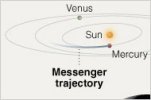
Mercury Flyby
The robot spacecraft, the first to visit the planet in more than three decades, was to pass about 124 miles above Mercury’s cratered surface at 2:04 p.m. Eastern time before continuing off on a path that is to bring it back three more times in the next three years before settling into orbit.
“Everything went really well,” Eric Finnegan, the Messenger systems engineer, said after the encounter. “All indications are that the spacecraft is operating normally.”
Mr. Finnegan, who monitored the flyby from the Messenger control center, said a faint signal beacon reappeared on schedule after the craft emerged from behind Mercury following the close approach.
During the flyby, Messenger’s suite of seven scientific instruments was scheduled to take more than 1,200 pictures of areas of the rocky planet not photographed before and make measurements of its surface chemical composition, wispy atmosphere and gravitational field.
“We expect many surprises,” said Dr. Sean C. Solomon of the Carnegie Institution of Washington, the mission’s lead investigator. Understanding Mercury’s history is pivotal to studying the evolution of the inner solar system and its four rocky planets, including
Earth, he said.
Messenger carried out the encounter on autopilot, having turned itself and its main antenna away from Earth on Sunday to get maximum protection from sun behind its highly reflective, heat-resistant sunshade. The craft is to execute hundreds of computerized commands during the flyby and contact Earth again on Tuesday, when it will begin sending back data from the flyby, scientists said.
The spacecraft, launched by
NASA in August 2004, is only about halfway through a circuitous 4.9 billion mile journey needed to maneuver it into orbit around Mercury, the planet nearest the sun. The journey involves more than 15 trips around the sun, including flying by the Earth once, passing Venus twice and three swings around Mercury before slipping into orbit on March 18, 2011.
“The complexity of this mission, with its numerous flybys and multitude of maneuvers, requires close and constant attention,” said Peter D. Bedini, project manager at the
Johns Hopkins University Applied Physics Laboratory in Laurel, Md., where the craft was designed and built and the mission is controlled.
Messenger will streak past Mercury at more than 16,000 miles per hour but a major goal of the encounter is to use the planet’s gravity to slow the craft by 5,000 m.p.h. This flyby and the two others in October of this year and September 2009 will not only result in more scientific observations but also bleed off enough speed for the spacecraft to orbit the planet.
“It is not at all easy getting into orbit around Mercury,” said Marilyn Lindstrom, NASA’s program scientist for the $446 million mission.
Messenger — short for Mercury Surface, Space Environment, Geochemistry and Ranging — is the first spacecraft to visit the planet since NASA’s Mariner 10 made three flybys between 1974 and 1975. During those sweeps, Mariner 10 mapped only 45 percent of the planet, leaving an entire hemisphere a mystery until now.
Mercury, with a diameter of 3,030 miles, is only slightly larger than Earth’s moon and is considered an oddball compared with other planets, Dr. Solomon said. It is the densest of all planets, indicating it must have an enormous iron core making up more than 60 percent of its mass. It is the only inner planet other than Earth with a global magnetic field, suggesting a molten core, he said.
It also has the most extreme temperature swings of any planet, with heat approaching 800 degrees Fahrenheit in the sunlight while the night side can reach 350 degrees below zero. Yet, radar readings from Earth suggest possible deposits of water ice in permanently shaded craters near the poles.