

You are using an out of date browser. It may not display this or other websites correctly.
You should upgrade or use an alternative browser.
You should upgrade or use an alternative browser.
Amazing Space
- Thread starter PoopaSwoof
- Start date
Users who are viewing this thread
Total: 2 (members: 0, guests: 2)

-
7Replies
-
2KViews
-
0Participant count
-
Participants list

freakofnature
Vampire
Cool! :thumbup

[video=youtube;xKKzFk-FiZM]http://www.youtube.com/watch?feature=player_embedded&v=xKKzFk-FiZM[/video]
I can never look now at the Milky Way without wondering from which of those banked clouds of stars the emissaries are coming. If you will pardon so commonplace a simile, we have set off the fire alarm and have nothing to do but to wait. I do not think we will have to wait for long..."
I can never look now at the Milky Way without wondering from which of those banked clouds of stars the emissaries are coming. If you will pardon so commonplace a simile, we have set off the fire alarm and have nothing to do but to wait. I do not think we will have to wait for long..."
- Arthur C. Clarke
“This colorful cosmic skyscape features a peculiar system of galaxies cataloged as Arp 227 some 100 million light-years distant. Swimming within the boundaries of the constellation Pisces, Arp 227 consists of the two galaxies prominent on the left; the curious shell galaxy NGC 474 and its blue, spiral-armed neighbor NGC 470.
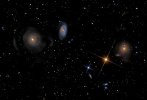
Click image for larger size.The faint, wide arcs or shells of NGC 474 could have been formed by a gravitational encounter with neighbor NGC 470. Alternately the shells could be caused by a merger with a smaller galaxy producing an effect analogous to ripples across the surface of a pond. Remarkably, the large galaxy on the right hand side of the deep image, NGC 467, appears to be surrounded by faint shells too, evidence of another interacting galaxy system. Intriguing background galaxies are scattered around the field that also includes spiky foreground stars. Of course, those stars lie well within our own Milky Way Galaxy. The field of view spans 25 arc minutes or about 1/2 degree on the sky.”
Click image for larger size.
- http://apod.nasa.gov/apod/ap110226.html

More Amazing Space
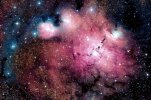
“When stars form, pandemonium reigns. A particularly colorful case is the star forming region Simeis 188 which houses an unusual and bright cloud arc cataloged as NGC 6559. Visible above are red glowing emission nebulas of hydrogen, blue reflection nebulas of dust, dark absorption nebulas of dust, and the stars that formed from them.
Click image for larger size.
“The Sleeping Beauty galaxy may appear peaceful at first sight but it is actually tossing and turning. In an unexpected twist, recent observations have shown that the gas in the outer regions of this photogenic spiral is rotating in the opposite direction from all of the stars! Collisions between gas in the inner and outer regions are creating many hot blue stars and pink emission nebula.
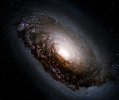
Click image for larger size. The above image was taken by the Hubble Space Telescope in 2001 and released in 2004. The fascinating internal motions of M64, also cataloged as NGC 4826, are thought to be the result of a collision between a small galaxy and a large galaxy where the resultant mix has not yet settled down. “
Click image for larger size.
- http://apod.nasa.gov/apod/ap110612.html

Brujahpriest
Jedi Hunter
That... is truly awe inspiring.

Godsloveapples
Between darkness and wonder
Calvin and Hobbes is the best comic that has ever been created. Bill Watterson communicates philosophy to his audience through his characters...I find his comics funny as well as informative and full of wisdom...
It's amazing what the night sky can do to your heart...Whenever I'm feeling down, I just look at the stars and peacefulness fills my heart..

80,525Threads

2,194,639Messages

5,014Members