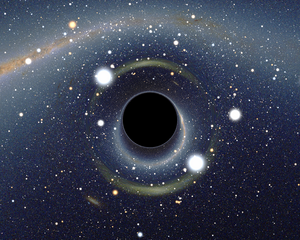
The current explanation of the universe's origins relies on clumsy assumptions and can't explain most subatomic particles. A small tweak to general relativity solves these problems - and seemingly proves the universe must have come from a black hole elsewhere.
Cosmology as it pertains to the origin of the universe seems heavy on speculation to me. It's still an interesting topic but I don't hang too much weight upon. Interesting hypothesis about black holes birthing universes.
[FONT=Arial, Helvetica, sans-serif]Most people think of a black hole as a voracious whirlpool in space, sucking down everything around it. But that’s not really true.
A black hole is a place where gravity has gotten so strong that the escape velocity is faster than light.
But what does that mean, exactly?
Gravity is what keeps us on the Earth, but it can be overcome. If you toss a rock up in the air, it will only go up a little ways before the Earth’s gravity slows it and pulls it back down. If you throw it a little harder, it goes faster and higher before coming back down. If you could throw the rock hard enough, it would have enough velocity that the Earth’s gravity could not slow it down enough to stop it. The rock would have enough velocity to escape the Earth.
For the Earth, that velocity is about 11 kilometers per second (7 miles/second). But an object’s escape velocity depends on its gravity: more gravity means a higher escape velocity, because the gravity will “hold onto” things more strongly. The Sun has far more gravity than the Earth, so its escape velocity is much higher—more than 600 km/s (380 miles/s). that’s 3000 times faster than a jet plane.
If you take an object and squeeze it down in size, or take an object and pile mass onto it, its gravity (and escape velocity) will go up.
At some point, if you keep doing that, you’ll have an object with so much gravity that the escape velocity is faster than light. Since that’s the ultimate speed limit of the Universe, anything too close would get trapped forever. No light can escape, and it’s like a bottomless pit
If you fall into a black hole, you’re doomed. Sure, once you fall in you can never get back out, but it turns out you’ll probably be dead before you get there.
The gravity you feel from an object gets stronger the closer you get. As you approach a stellar-mass black hole feet-first, the force of gravity on your feet can be thousands of times stronger than the force on your head! This has the effect of stretching you, pulling you apart like taffy. Tongue-in-cheek, scientists call this “spaghettification.” By the time you reach the black hole, you’ll be a thin stream of matter many miles long. It probably won’t hurt though: even falling from thousands of kilometers away, the entire gory episode will be over in a few milliseconds.
You may not even make it that far. Some black holes greedily gobble down matter, stealing it from an
orbiting companion star or, in the case of super massive black holes, from surrounding gas clouds. As
the matter falls in, it piles up into a disk just outside the hole. Orbiting at huge speeds, the matter in this
accretion disk gets extremely hot—even reaching millions of degrees. It will spew out radiation, in particular
high-energy X-rays. Long before the black hole could rip you apart you’d be fried by the light.
But suppose you somehow manage to survive the trip in.
What strange things await you on your way down into forever?
Once you pass the point where the escape velocity is faster than light, you can’t get out. This region is
called the event horizon. That’s because no information from inside can escape, so any event inside is forever beyond our horizon.
If the black hole is rotating, chaos awaits you inside. It’s a maelstrom as in falling matter turns back on the incoming stream, crashing into you like water churning at the bottom of a waterfall. At the very core of the black hole the seething matter finally collapses all the way down to a point. When that happens, our math (and intuition) fail us. It’s as if the matter has disappeared from the Universe, but its mass is still there.
At the singularity, space and time as we know them come to an end.
and poopa,...i can see where it is possible
[/FONT]
That's right! Actually mathematically the only difference between the event horizon and our cosmic horizon is that in the one case we're on the outside looking in, and the other, we're on the inside looking out. But that's just mathematics for you.
Anyway, this idea has been floating around for awhile. It's a very good idea, I think one of the best theories is from Lee Smolin if you ever heard of him.
If you're referring to his idea about a multiverse where universes spawn child universes that are selected by their ability to spawn more universes then yeah, it's an interesting idea.