You are using an out of date browser. It may not display this or other websites correctly.
You should upgrade or use an
alternative browser.
Can somebody please explain
- Messages
- 4,516
- Reaction score
- 13
- Tokenz
-
237.37z
Slinky physics?
This kinda blew my mind.
I know that there is something profound about this but I cant wrap my tiny little mind around it.:eek
- Messages
- 3,226
- Reaction score
- 0
- Tokenz
-
0.00z
- Messages
- 12,886
- Reaction score
- 0
- Tokenz
-
0.00z
Here's another mind boggling physics trick...
[video=youtube;k9ueZTrRyEY]http://www.youtube.com/watch?v=k9ueZTrRyEY[/video]
- Messages
- 7,475
- Reaction score
- 448
- Tokenz
-
2.25z
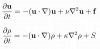 The Navier-Stokes Equations for the velocity in a compact vector notation (top) and
the equation for a density moving through the velocity field (bottom).
Mathematically, the state of a fluid at a given instant of time is modeled as a velocity vector
field: a function that assigns a velocity vector to every point in space. Imagine the air that
occupies a room, its velocity will vary due to the presence of heat sources, air drafts, etc. For
example, the velocity of the air near a radiator will predominantly be pointing in the upward
direction due to heat rising. The distribution of velocities within a room is also quite complex as
is evident when watching the smoke rising from a cigarette or the motion of dust particles in
the air.The Navier-Stokes Equations are a precise description of the evolution of a velocity field
over time. Given the current state of the velocity and a current set of forces, the equations tell
us precisely how the velocity will change over an infinitesimal time step. Figure 1 (top) depicts
these equations in a compact vector-like notation. Very roughly the equation states that the
change in velocity is due to the three terms on the right hand side of the equal sign.
- Messages
- 24,161
- Reaction score
- 780
- Tokenz
-
3,703.35z
 The Navier-Stokes Equations for the velocity in a compact vector notation (top) and
the equation for a density moving through the velocity field (bottom).
Mathematically, the state of a fluid at a given instant of time is modeled as a velocity vector
field: a function that assigns a velocity vector to every point in space. Imagine the air that
occupies a room, its velocity will vary due to the presence of heat sources, air drafts, etc. For
example, the velocity of the air near a radiator will predominantly be pointing in the upward
direction due to heat rising. The distribution of velocities within a room is also quite complex as
is evident when watching the smoke rising from a cigarette or the motion of dust particles in
the air.The Navier-Stokes Equations are a precise description of the evolution of a velocity field
over time. Given the current state of the velocity and a current set of forces, the equations tell
us precisely how the velocity will change over an infinitesimal time step. Figure 1 (top) depicts
these equations in a compact vector-like notation. Very roughly the equation states that the
change in velocity is due to the three terms on the right hand side of the equal sign.

- Messages
- 149
- Reaction score
- 0
- Tokenz
-
0.00z
Can someone translate that is less beefy people words:eek
Back Again... but reformed...
- Messages
- 4,570
- Reaction score
- 2
- Tokenz
-
0.00z
That was fun reading